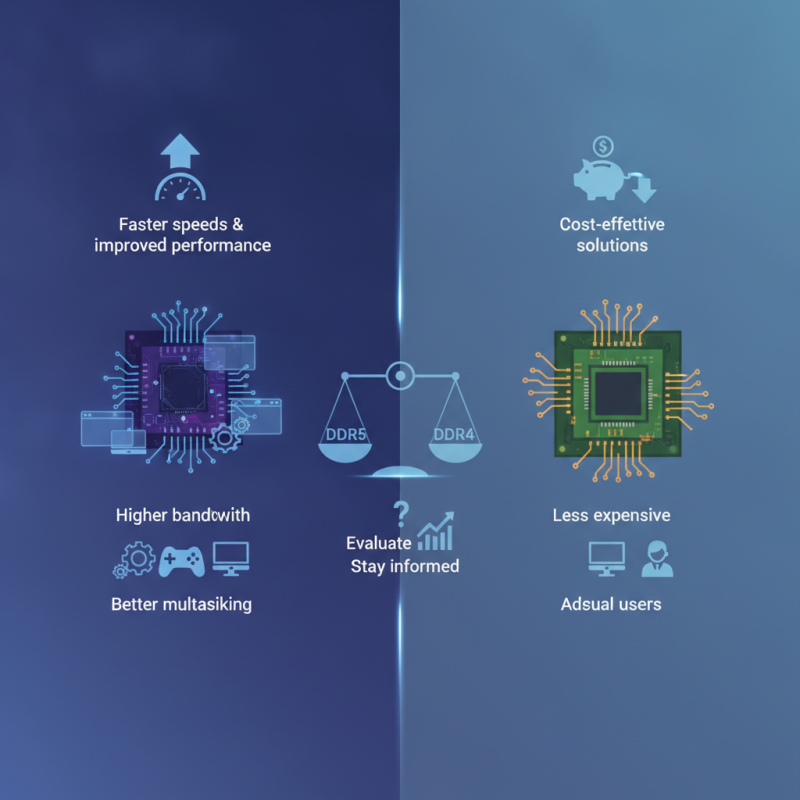
As we approach 2026, the debate over DDR5 vs DDR4 comparison becomes increasingly relevant. Many users wonder which RAM type best suits their needs. DDR5 promises faster speeds and improved performance for demanding applications. However, DDR4 still holds its ground for cost-effective solutions.
The differences between these two generations of RAM are significant. DDR5 offers higher bandwidth, which means better multitasking capabilities. Yet, it is crucial to consider your specific use case. For casual users, DDR4 might still be adequate and less expensive. Meanwhile, gamers and professionals may benefit more from the enhancements of DDR5.
Choosing RAM is not a simple task. Each option has its strengths and weaknesses. Evaluating performance against cost is essential. As technologies evolve, staying informed helps make the right decision. Understanding the DDR5 vs DDR4 comparison can ensure you choose RAM that truly meets your requirements.
DDR4 Overview: Key Features and Performance Metrics
DDR4 RAM has been a staple in the tech industry for several years. It offers a solid balance between performance and price, making it popular among gamers, content creators, and general users. The standard data rate for DDR4 typically ranges from 2133 MT/s to 4266 MT/s, providing sufficient speed for most applications. According to industry benchmarks, DDR4 can deliver bandwidth of up to 25.6 GB/s, which suffices for moderate multitasking and gaming without significant issues.
However, looking ahead to 2026, there are concerns about DDR4’s longevity. Newer applications and operating systems demand higher memory performance. As software evolves, the limitations of DDR4 may hinder optimal performance. Some reports suggest that users could experience bottlenecks as more demanding applications emerge. Furthermore, while DDR4 is generally reliable, it may not sustain the rapid advancements in data-intensive tasks like AI and machine learning.
The efficiency of power consumption is another critical aspect. DDR4 operates at a voltage of 1.2V, which is lower than its predecessor, DDR3. This reduction contributes to energy savings, yet it also means that DDR4 might not keep up with the efficiency improvements seen in newer RAM technologies. Users should weigh these factors carefully. As tech continues to progress, DDR4 may soon face pressures that challenge its relevance in an ever-evolving market.
DDR5 Introduction: Innovations and Advantages Over DDR4
DDR5 RAM represents a significant leap over its predecessor, DDR4, primarily through increased bandwidth and capacity. DDR5 offers data rates starting at 4800 MT/s, compared to the maximum of 3200 MT/s for DDR4. This means that DDR5 can significantly improve data transfer speeds for applications requiring more memory bandwidth. Industry reports predict that DDR5’s efficiency will result in improved performance for gaming, content creation, and data-intensive tasks.
Another innovative feature of DDR5 is its ability to support higher module capacities. Where DDR4 typically maxes out at 32GB per module, DDR5 reaches 64GB and can go higher. This allows users to build systems with up to 512GB of RAM, enhancing multitasking capabilities. However, the real-world benefits may vary based on specific use cases. For everyday office tasks, DDR4 may still be sufficient.
Moreover, DDR5 introduces advanced power management, reducing power consumption during heavy workloads. Yet, with advanced technology comes higher costs. Adoption rates might lag behind expectations as users weigh the price against the perceived performance boost. Some may find the transition less crucial, especially with DDR4 still capable of handling many applications efficiently.
DDR5 vs DDR4 Comparison Which RAM Is Best for You in 2026?
| Feature |
DDR4 |
DDR5 |
| Data Rate |
2133-3200 MT/s |
4800-8400 MT/s |
| Bandwidth |
17-25.6 GB/s |
38.4-67.2 GB/s |
| Voltage |
1.2V |
1.1V |
| Capacity per Module |
32GB max |
128GB max |
| Latency |
15-19ns |
< 30ns |
| Dual Channel Support |
Yes |
Yes |
| Price (approx.) |
Lower |
Higher |
Performance Comparison: Speed, Bandwidth, and Latency Analysis
When comparing DDR5 and DDR4 memory, speed, bandwidth, and latency play crucial roles. DDR5 RAM delivers higher speeds, reaching up to 8400 MT/s. In contrast, DDR4 maxes out around 3200 MT/s. This jump in speed allows more data to be processed simultaneously.
Bandwidth is another significant factor. DDR5 offers double the bandwidth compared to DDR4. This results in better performance in demanding applications, such as gaming and 3D rendering. Users may notice faster load times and improved frame rates.
**Tip:** If you’re a gamer, consider DDR5. Its faster speeds improve overall performance. However, assess if your motherboard supports DDR5, or you might face compatibility issues.
Latency is a mixed bag. DDR5 may show slightly higher latency due to advanced features. In some cases, this can lead to slower response times in specific tasks. It's essential to evaluate how this might affect your work.
**Tip:** When upgrading, check your system requirements. Balancing between speed and latency is important for optimal performance. Always consider how much memory you truly need for your applications.
Cost Considerations: DDR4 vs. DDR5 Pricing Trends in 2026
As we look ahead to 2026, the cost differences between DDR4 and DDR5 RAM are becoming clearer. DDR4 has long been the standard, offering a balance between performance and affordability. However, as technology advances, DDR5 is gaining traction. This new standard boasts faster speeds and better efficiency, but at a price.
Consumers in 2026 face critical decisions based on budget. DDR4 prices are stabilizing, making it accessible for many users. Yet, the allure of DDR5 is strong, promising enhanced performance for gamers and professionals alike. Still, the upfront cost may deter some. It's essential to assess whether the performance gains justify the investment.
The landscape is shifting, and trends indicate DDR5 could become more mainstream. However, it may not be the obvious choice for everyone. Users with basic needs might find DDR4 sufficient. Reflecting on personal requirements and budget is crucial. Balancing performance needs with financial limitations will guide the best choice in RAM.
Best Use Cases: Choosing the Right RAM for Your Needs in 2026
When choosing RAM in 2026, understanding the difference between DDR4 and DDR5 is essential. DDR4 is known for its reliability and cost-effectiveness. It's suitable for everyday tasks like browsing and office applications. However, as software demands evolve, DDR5 provides faster speeds and improved efficiency. It excels in intensive tasks such as gaming and video editing.
Tips: Consider your current usage. If you mainly browse and stream, DDR4 suffices. For gamers and professionals, DDR5 is worth the investment. Performance gaps could widen in the future, making DDR5 a more strategic choice.
The size of the RAM also matters. More memory allows for better multitasking. Applications will increasingly require more data handling. Ensure your system can accommodate the RAM you choose. Mismatched specifications may lead to slower performance. Think about your future needs before making a decision. Investing now could save you frustration later.
FAQS
: DDR5 offers higher bandwidth and capacity, greatly improving data transfer speeds.
DDR5 starts at 4800 MT/s, while DDR4 maxes out at 3200 MT/s.
DDR5 supports up to 64GB per module, enabling systems with up to 512GB of RAM.
For simple tasks like browsing, DDR4 is often sufficient and more cost-effective.
DDR5 incorporates advanced power management, reducing consumption during heavy workloads.
The higher cost and limited perceived performance improvements may deter many from upgrading.
Assess your usage. If you mainly browse, DDR4 may suffice; for gaming, DDR5 is better.
Applications will require more data handling. Investing in DDR5 now may prevent future issues.
Yes, using incompatible RAM can lead to slower performance or system instability.
As software evolves, DDR4 may soon struggle, causing frustration for users with increasing demands.
Conclusion
In the "DDR5 vs DDR4 comparison," we explore the evolution of RAM technology as we approach 2026. DDR4 has established itself with its solid performance metrics and key features, making it a reliable choice for many users. However, DDR5 introduces significant innovations, boasting improved speed, bandwidth, and lower latency, which can greatly enhance overall system performance.
When analyzing the performance aspects, DDR5 demonstrates substantial advantages over DDR4, especially in high-demand applications. However, cost considerations also play a vital role, with pricing trends for DDR4 remaining attractive in comparison to the emerging DDR5 RAM. Ultimately, the best RAM choice depends on individual needs, including usage scenarios such as gaming, content creation, or general productivity tasks, where one must weigh the benefits of superior performance against budget constraints.

 CoreByte